The Honest Truth About Grey Blending
Most women going grey are being sold the wrong service, and nobody in the industry is telling them.
I am Marta Davies. I run Hair By Marta in Market Drayton, and a large part of my week is spent fixing grey blending that has gone wrong somewhere else. Banding, brassiness, harsh regrowth lines, hair that has been stretched too thin by aggressive lightening. The same problems, over and over, in women who were told this would be the easy way out of root colour.
I wrote this because I am tired of watching women lose confidence in their hair when the real issue is that the work was never planned to begin with. So this is the version nobody else is going to write for you. Read it before you book anything, anywhere.
Why Grey Transitions Fail
There are four ways grey blending goes wrong, and I see all four every single week.
The first is leaving it to grow out naturally with no plan. It sounds like the simplest option, but what actually happens is months of looking at a sharp line between your colour and your regrowth, the panic kicks in around week eight, and most women cave and go back to full root colour. The transition never finishes because nothing was ever structured to carry them through the middle.
The second is lightening too aggressively in one session. A colourist tries to soften the contrast quickly, lifts the regrowth too hard, and the hair pays for it. You leave the salon happy because the line is gone, but six weeks later the condition has dropped, the tone has shifted and the next appointment is already a recovery job rather than a progression.
The third is spacing appointments too far apart. Grey blending only works when the stages are close enough together that brightness builds. Leave it twelve or sixteen weeks between sessions and the work resets each time. You are paying for highlights that are doing nothing because nothing is being layered.
The fourth is switching between full coverage and highlights depending on how the regrowth feels in any given month. This is the one that drags transitions out for years. Every reactive decision undoes the last one. The hair never gets a chance to settle into a direction.
If any of these sound like what has been happening to you, you are not the problem. The plan was.
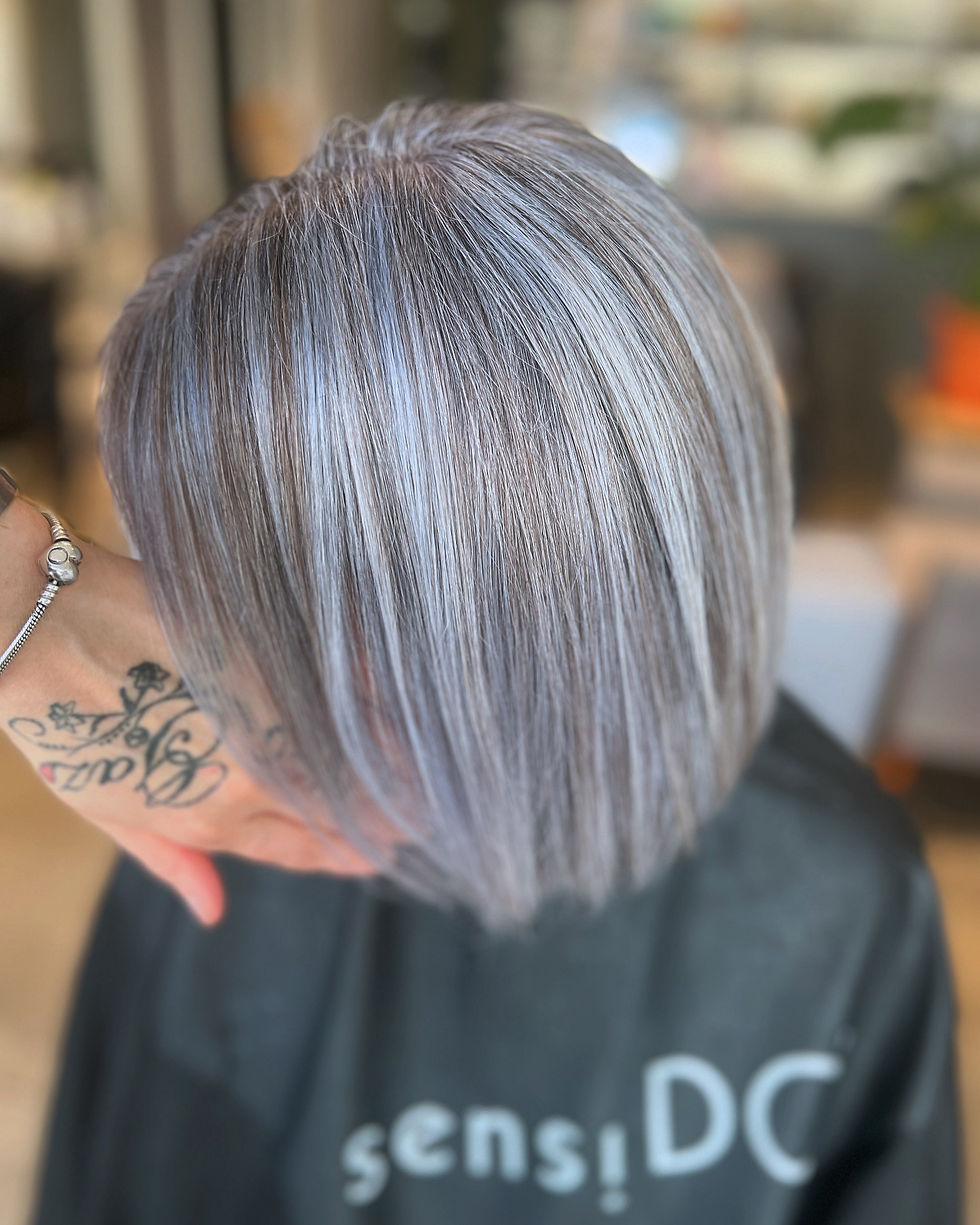
The Four Things You Need To Understand Before You Transition
Before any colourist puts a single foil in your hair, four things should be assessed honestly. If they are not, the transition will stall.
Your regrowth contrast. This is the gap between your natural grey and the colour currently sitting on your hair. The wider the gap, the more stages you need. A woman with a level four base growing through fifty percent grey is on a completely different timeline to a woman with a level seven base growing through twenty percent grey. Anyone who quotes you the same plan for both is guessing.
The percentage of grey you actually have. Most women overestimate or underestimate this by a wide margin. The percentage matters because it tells your colourist how much placement is needed and where. Below thirty percent, you are blending. Above seventy percent, you are essentially going lighter to meet the grey. The middle ground is where most of the technical work lives.
The condition of your hair right now. A transition is a series of services stacked on top of each other over months. If the canvas is already compromised, by box dye, by previous over lightening, by heat damage, the plan has to account for that before it accounts for the colour. Skipping this step is how women end up with grey blending that has technically worked but feels like straw.
Your real timeline. Most women want this done in three months. Most transitions take six to eight. Anyone promising you faster than that, on hair that has been coloured for years, is either skipping stages or about to damage your hair. There is no shortcut. There is only a structured plan or a stalled one.
What The Middle Of A Transition Actually Feels Like
Nobody talks about this part, so I will.
Month one is the easiest. You have just had a session, the contrast is softer than it has been in years, and you feel like you have made the right decision.
Month two is where the doubt starts. The brightness is still there but the regrowth is creeping back in, and the voice in your head asks whether you should just go back to full coverage and forget the whole thing.
Month three is the wobbly middle. This is the point where most women quit. The hair is in transition, which by definition means it does not look finished, and if you do not have a colourist who has prepared you for this stage you will give up. The ones who get through it are the ones who were told in advance that this would happen.
Month four onwards is where the work starts paying off. The brightness builds, the regrowth softens, the maintenance window stretches, and you start to see what the end actually looks like.
By month six to eight you are out the other side. Less colour, less time in the chair, less money over the year, and hair that finally looks like yours.
The middle is the test. Anyone selling you grey blending without preparing you for it is setting you up to fail.

The Two Starting Points
There are only two places a transition can begin from, and which one you fall under decides everything that follows.
A darker or previously coloured base. If your hair currently sits darker than your natural grey, or if there is years of colour build up holding tone in the lengths, the first stage is correction. You cannot blend toward grey from a base that is fighting you. Correction rebalances the canvas so that the structured highlighting sessions afterwards can actually do their job. Skipping this step is the single most common reason transitions fail on darker hair.
A lighter base with no correction needed. If your hair is already sitting lighter and there is no significant build up to work through, the transition is shorter and the path is more direct. Strategic placement, tonal refinement, controlled brightness over a handful of sessions. The work is still structured, but the canvas is already cooperating.
You probably already know which one you are. Most women do. If you are unsure, that is what a consultation is for.
What I Spend My Week Fixing
A large part of my work is corrective. Women come to me after their grey blending has gone wrong somewhere else, and the same four problems show up again and again.
Banding. Stripes of colour through the lengths because highlights have been placed in the same sections every visit, with no thought to layering or rotation. It looks fine for the first few months, then becomes obvious and very hard to undo.
Brassiness. Tone that has slipped because the lightening was pushed too far, the toner was a quick afterthought, or the aftercare was never explained. Hair going grey naturally has a cool tone underneath. If your blending is warming up between appointments, the work was not balanced.
Harsh demarcation lines. The exact thing grey blending is supposed to soften. When it is done badly, the line just moves further down the head instead of disappearing. You end up with two distinct colours and a horizontal divider between them.
Damage from over lightening. The hair that comes to me after eighteen months of aggressive blending often needs a recovery plan before any further colour can be added. This is the cost of rushing the process.
I am not writing this to scare you. I am writing it because the women sitting in my chair fixing this work are usually the ones who were not told any of this before they started.
What Working With Me Actually Looks Like
Everything I have just walked you through is exactly why I built the Signature Blend Programme. It is the structured version of what most salons do reactively.
The stages are mapped from the start. The spacing between appointments is held tight enough for the brightness to build instead of reset. The condition of your hair is protected at every stage with bond support and moisture work built into the service rather than sold as an extra. You know what your maintenance looks like at the end of it before you ever begin.
If you have read this far and recognised yourself, this is the next step. The full structure, both pathways and the investment for each is on the programme page.


Comments